2022 Honda CRF250F Brake Fluid Replacement - Page 1
Article Last Updated: June 5, 2026Next
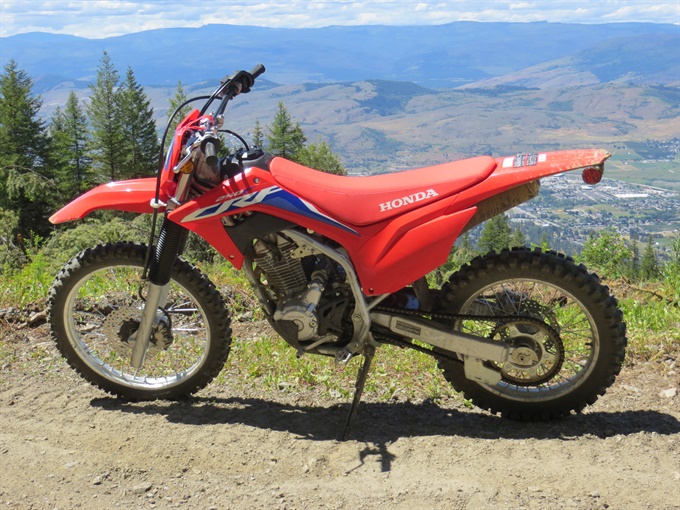
This is a step-by-step guide to replacing the brake fluid on a Honda CRF250F. The information on this page is based on information contained in the official Honda CRF250F service manual, 2021 (part no. 61K9903) which covers model years 2019 - 2022. The author is not aware of any relevant mechanical changes to the CRF250F models for the model years 2023-2025, so this guide should apply to those as well. Check with a Honda dealer if in doubt or get the latest version of the service manual.
Disclosure: While the author has attempted to provide correct and complete information, sometimes errors or omissions may occur. By using this document and following the procedures and advice below, the user assumes all risk and responsibility for injury or damage to their motorcycle. The author has been servicing motorcycles for many years (not as a profession) and is mostly self-taught (no formal training in motorcycle servicing). It is recommended that you consult the Honda CRF250F owner’s manual and/or service manual.
Information from Honda CRF250F Service Manual
Recommended service interval for brake fluid replacementEvery 2 years
Torque Specifications
Front and rear caliper bleed valve: 5.4 N.m (4.0 lbf.ft)
Front and rear reservoir cap screw: 1.5 N.m (1.1 lbf.ft)
Rear brake caliper guard bolts: 11.9 N.m (9 lbf.ft)
Front brake lever adjuster locknut: 5.9 N.m (4.4 lbf.ft)
Rear brake pedal push rod locknut: 5.9 N.m (4.4 lbf.ft)
Service Manual Warnings
- Spilled brake fluid will severely damage plastic parts and painted surfaces. It is also harmful to some rubber parts. Be careful whenever you remove the reservoir cap; make sure the front reservoir is horizontal first.
- A contaminated brake disc or pad reduces stopping power. Discard contaminated pads and clean a contaminated disc with quality brake degreasing agent.
- Check the brake system by applying the brake lever or pedal after air bleeding.
- Never allow contaminants (dirt, water, etc.) to get into an open reservoir.
- Once the hydraulic system has been opened, or if the brake feels spongy, the system must be bled.
- Always use fresh Honda DOT 4 brake fluid from a sealed container when servicing the system. Do not mix different types of fluid, they may not be compatible.
- Always check brake operation before riding the motorcycle.
Hydraulic System Inspection
Firmly apply the brake lever or pedal; if it feels spongy or soft, bleed the brakes to remove air from the system.
Inspect the brake lines and fittings for cracks, deterioration and leaks. Tighten any loose fittings. Replace damaged or deteriorated brake lines and fittings.
Additional Brake Checks
Check brake pads for wear.
Check front brake lever adjustment and operation.
Check rear brake pedal height and operation.
Service Manual Instructions for Brake Fluid Replacement
The service manual divides the process into two main tasks: (1) brake fluid draining and (2) brake fluid filling / air bleeding.
Except for removing/installing the rear brake caliper guard, the same procedure applies to both front and rear brakes.
Brake Fluid Draining
- Check that the master cylinder is parallel to the ground.
- Remove the reservoir cover screws, reservoir cover, set plate (rear only) and diaphragm.
- Remove the rear brake caliper guard.
- Connect a bleed hose to the brake caliper bleed valve.
- Loosen the brake caliper bleed valve and pump the brake lever or pedal.
- Stop operating the brake when no more fluid flows out of the bleed valve.
- Tighten the brake caliper bleed valve to the specified torque: 5.4 N.m (4.0 lbf.ft) (when finished with the brake fluid replacement procedure).
Brake Fluid Filling / Air Bleeding (manual method)
- Wrap a clean shop towel around the reservoir to prevent brake fluid from spilling.
- Fill the reservoir to the upper-level line with the recommended brake fluid from a sealed container. Do not mix different types of fluid; they are not compatible.
- Add fluid when the fluid level in the reservoir is low. Check the fluid level often while bleeding the brake to prevent air from being pumped into the system.
- If not already connected, connect a bleed hose to the bleed valve.
- Pressurize the system with the brake lever or pedal until there are no air bubbles in the brake fluid flowing out of the small hole in the reservoir and lever or pedal resistance is felt.
- 1. Squeeze the brake lever or push the brake pedal, open the bleed valve 1/4 turn and then close the bleed valve. Note: do not release the brake lever or pedal until the bleed valve has been closed.
- 2. Release the brake lever or pedal slowly and wait several seconds after it reaches the end of its travel.
- 3. Repeat steps 1 to 2 until there are no air bubbles in the bleed hose.
- After bleeding air completely, tighten the bleed valve to the specified torque: 5.4 N.m (4.0 lbf.ft).
- Install the rear brake caliper guard and tighten the bolts to the specified torque: 11.9 N.m (9 lbf.ft).
- Fill each reservoir with the recommended brake fluid to the upper-level line.
- Front: Install the diaphragm and reservoir cover. Tighten the reservoir cover screws to the specified torque: 1.5 N.m (1.1 lbf.ft).
- Rear: Straighten the diaphragm and install it in the rear master cylinder. Be careful not to deform the diaphragm (do not bend it). Install the set plate. Install the reservoir cover. Install and tighten the reservoir cover bolts to the specified torque: 1.5 N.m (1.1 lbf.ft).
- Inspect the hydraulic system.
Next